
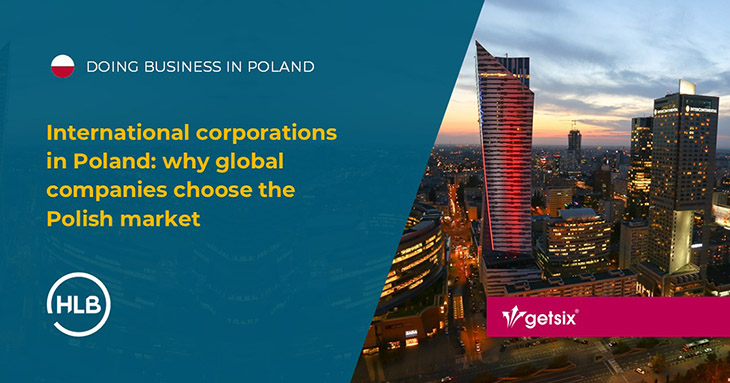
International corporations in Poland: why global companies choose the Polish market
Poland is no longer chosen by global companies only for labour-cost reasons. It is increasingly used as a location for technology, R&D, business services, manufacturing and logistics. According to ABSL, at the end of Q1 2025 Poland had 2,081 business services centres operated by 1,258 investors from 50 countries.
In this article:
Why do international corporations choose Poland?
Poland’s attractiveness now results from several advantages: access to qualified specialists, EU membership, developed infrastructure, a strong industrial base, experience in international business processes and a sizeable domestic market.
The country has become a location for global functions such as technology, finance, accounting, HR, cybersecurity, logistics, R&D and advanced manufacturing. Between January 2024 and March 2025, 61 new centres were established, mainly in IT and R&D.
Where is the technology and R&D shift visible?
Visa is developing a global Technology and Product Hub in Poland, initially planned for up to 1,500 specialists. Its capabilities include digital payments, cybersecurity, AI, payment network resilience and product development.
Google is building a Google Cloud engineering centre in Warsaw, and its Polish organisation has grown to nearly 3,000 employees. Intel has one of its largest European R&D centres in Gdańsk.
Microsoft announced PLN 2.8 billion for cloud, AI and cybersecurity infrastructure in Poland by June 2026. This strengthens Poland’s role as a digital infrastructure point in Central and Eastern Europe.
How are business services in Poland changing?
Kraków, Wrocław, Warsaw, Tricity, Łódź, Katowice and Poznań support international groups in finance, accounting, HR, payroll, procurement, compliance, data analytics and cybersecurity.
Shell Business Operations in Kraków shows both the scale of the sector and its transformation. Simple processes are being automated, while financial analytics, data management, digital transformation support and multi-market coordination are gaining importance.
UBS, despite restructuring in 2025, remains active in Kraków and Wrocław. HSBC Service Delivery in Kraków supports the global group in technology, operations, finance and risk.
What is the role of manufacturing, logistics and e-commerce?
Poland remains part of European supply chains. Volkswagen Poznań employs around 9,000 people and operates four plants, while the wider Volkswagen Group in Poland employs more than 22,000 people.
Mercedes-Benz Manufacturing Poland invested around EUR 600 million in an engine and battery factory in Jawor. At the end of 2025, the plant employed around 1,200 people.
Amazon illustrates Poland’s role in logistics and e-commerce. By the end of 2024, the company employed more than 19,000 people in Poland, and its distribution centres also serve a broader European sales and delivery network.
What should foreign investors analyse?
Poland is not a uniform low-cost labour market. It is a mature investment location for an operational centre, technology hub, manufacturing base, logistics point or competence centre.
Regional choice matters: Warsaw attracts management and finance; Kraków is strong in business services and IT; Wrocław combines technology, engineering and industry; Tricity offers engineering, logistics and R&D potential.
Investors should assess labour and energy costs, demographics, talent availability, automation pressure and geopolitical uncertainty. Investing in Poland requires sectoral and regional analysis before decisions are made.
International corporations in Poland: why global companies choose the Polish market.
If you have any questions regarding this topic or if you are in need for any additional information – please do not hesitate to contact us:
CUSTOMER RELATIONSHIPS DEPARTMENT
ELŻBIETA
NARON-GROCHALSKA
Head of Customer Relationships
Department / Senior Manager
getsix® Group

***