

Business Review Poland – June 2026
June 2026 brought important regulatory and business developments for companies operating in Poland, especially in the areas of accounting services in Poland, tax services Poland, payroll services Poland, HR and payroll services in Poland, VAT in Poland, KSeF, JPK_CIT, business services Poland and compliance for international investors. For entrepreneurs, foreign companies, management boards and finance teams, doing business in Poland increasingly requires reliable accounting, well-organised tax settlement in Poland, effective HR services Poland and strong internal procedures supporting digital reporting, VAT compliance and payroll obligations.
In this monthly business review, we present the most important developments from the past month that affect the conditions for doing business in Poland, including changes relevant for companies using or considering accounting outsourcing in Poland, financial and accounting services in Poland, consulting services Poland, tax declarations in Poland, register company in Poland processes and broader investment activity connected with investing in Poland.
In this article:
AI in HR in Poland – new obligations for employers in recruitment and employee assessment
The article published on 9 June 2026 highlights the growing importance of compliance when using artificial intelligence in HR in Poland, especially in recruitment, candidate screening, employee assessment, performance monitoring and workforce management. Under the EU AI Act, certain employment-related AI systems may be classified as high-risk AI systems, particularly where they are used for recruitment or selection, targeted job advertising, filtering applications, evaluating candidates, allocating tasks, monitoring performance or supporting decisions on promotion or termination. For employers in Poland, this means that the use of AI in HR should not be treated only as an IT or innovation project. Companies need to map where AI tools are used, assess whether system outputs influence decisions concerning candidates or employees, ensure genuine human oversight, inform affected individuals and verify compliance with GDPR. A key practical obligation already relevant for businesses is AI literacy under Article 4 of the AI Act, which requires providers and deployers of AI systems to ensure an appropriate level of AI knowledge among staff using such systems. The original regulatory timeline indicated that rules for high-risk systems listed in Annex III, including employment-related systems, were expected to apply from 2 August 2026, while EU-level discussions have also included possible postponements for certain high-risk areas, including employment, to 2 December 2027. Regardless of the final timeline, companies should use 2026 to prepare documentation, HR procedures, provider verification processes and staff training.
Read the article for more details: AI in HR in Poland – new obligations for employers



JPK_KR_PD and foreign branches – new approach of the Polish tax authority to reporting accounting records
The article published on 10 June 2026 discusses an important individual tax ruling issued by the Director of the National Revenue Information on 2 April 2026, ref. no. 0111-KDIB1-2.4010.34.2026.2.EKB, concerning JPK_KR_PD and foreign branches. The ruling is particularly relevant for Polish companies with self-accounting foreign branches, i.e. branches that keep their own accounting books abroad and prepare separate financial statements under local accounting rules. The tax authority confirmed a favourable position for taxpayers: the obligation to keep and submit accounting books under Article 9(1c) and 9(1e) of the Polish Corporate Income Tax Act should not cover accounting books kept independently by such foreign branches. In practice, this reduces the risk that Polish companies will have to adapt the full accounting books of foreign branches to the Polish JPK_KR_PD logical structure. However, this does not remove the parent company’s responsibility for correctly determining income, loss, tax base and CIT due in Poland. Companies should therefore document whether the branch is genuinely self-accounting, identify which branch data affects Polish CIT settlements, verify how data is included in combined financial statements and clearly describe the adopted reporting approach in accounting policies and tax documentation.
Read the article for more details: JPK_KR_PD and foreign branches – new tax ruling
Invoice visualization in KSeF – when can a PDF create VAT risk?
The article published on 8 June 2026 focuses on invoice visualization in the National e-Invoicing System, KSeF, in Poland and the VAT risks connected with PDF versions of structured invoices. After the mandatory implementation of KSeF, the core tax document is the structured invoice in XML format, while the PDF visualization should serve only as a readable representation of the data submitted to KSeF. The key rule is that the visualization must remain consistent with the structured invoice. The article refers to an individual tax interpretation dated 30 April 2026, in which the Director of the National Tax Information indicated that differences between the XML invoice and the PDF visualization may mislead the contractor as to the transaction terms. Risk may arise where the PDF shows a different amount payable, includes additional charges, discounts or deductions outside the XML structure, changes descriptions of goods or services, omits settlement-relevant data or uses field names that change the meaning of the invoice. In extreme cases, the tax authority may consider whether Article 108 of the Polish VAT Act applies, which may create a risk of treating the PDF as a separate invoice showing VAT. For businesses in Poland, this means that KSeF implementation should include testing PDF templates, verifying consistency between XML and PDF data, adding KSeF numbers and QR codes where required and defining internal controls for corrections, advance payments, discounts, multiple VAT rates and complex transactions.
Read the article for more details: Invoice visualization in the National e-Invoicing System in Poland
KSeF and VAT deduction – invoices in the system, outside the system and obligations of VAT-exempt taxpayers
The article published on 19 June 2026 explains how the National e-Invoicing System, KSeF, in Poland affects the timing of input VAT deduction. Companies should distinguish between three different situations: an invoice issued directly in KSeF, an invoice issued outside KSeF despite the obligation to use the system, and a structured invoice issued in offline or offline24 mode. For invoices issued directly in KSeF, the decisive moment for receipt is generally the date on which the KSeF number is assigned, provided that the general conditions for VAT deduction are met. For example, if a KSeF number is assigned on 12 May 2026, that date may be relevant for determining the VAT deduction period. If a supplier issues an invoice outside KSeF despite being required to use the system, the current favourable approach of the Polish tax authorities indicates that the buyer should not automatically lose the right to deduct VAT, provided the transaction is genuine, the invoice meets formal requirements and the general deduction conditions are satisfied. In such cases, the date of actual receipt of the document may be relevant. In offline24 mode, the invoice should generally be submitted to KSeF no later than the next business day after it is issued, and the KSeF number may determine the receipt date for VAT purposes. The article also underlines that VAT-exempt taxpayers may still have KSeF obligations. If a VAT-exempt entrepreneur is required to issue an invoice, for example at the request of another business customer, or voluntarily documents a sale with an invoice, they may need to issue it through KSeF. A bill is not a freely interchangeable substitute for an invoice. The article also notes a transitional simplification for the smallest taxpayers in 2026: until the end of 2026, invoices may be issued outside KSeF if the total gross value of sales documented by such invoices in a given month does not exceed PLN 10,000.
Read the article for more details: National e-Invoicing System (KSeF) and VAT deduction in Poland
JPK reporting deadline in Poland extended – key information for companies
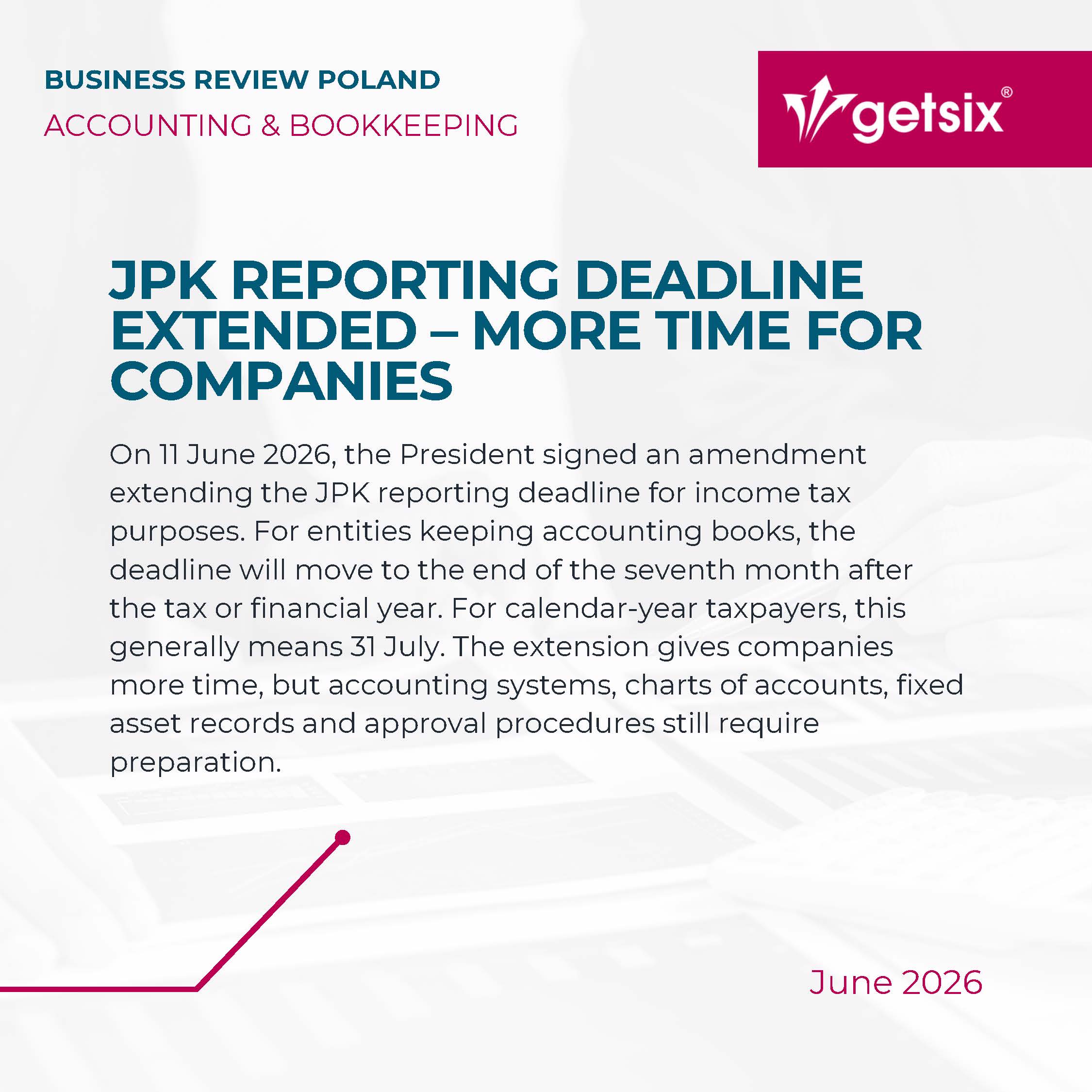
The article published on 22 June 2026 presents the official extension of the JPK reporting deadline in Poland for income tax purposes. On 11 June 2026, the President of the Republic of Poland signed an amendment to the Polish Personal Income Tax Act, the Corporate Income Tax Act and the Act on Lump-Sum Income Tax. The amendment extends the deadline for submitting JPK files for income taxes by entities keeping accounting books to the end of the seventh month after the end of the tax year or financial year. In practice, for taxpayers whose tax year corresponds to the calendar year, the deadline will generally fall on 31 July. This change is important because annual financial statements in Poland should be approved within six months from the balance sheet date, and only after approval are the accounting books finally closed. The extended deadline reduces the risk of submitting JPK data before the final closing of accounting books and should help ensure greater consistency between accounting records, financial statements and income tax settlements. However, the extension does not change the scope of reporting and should not delay implementation work. Companies still need to prepare accounting systems, charts of accounts, fixed asset records, JPK markers, contractor data, data mapping procedures and internal approval workflows. The amendment also confirms that the UPL-1 power of attorney may be used for signing tax books submitted in JPK structures for income tax purposes. The provisions extending the deadline are expected to enter into force on 1 July 2026, while provisions concerning powers of attorney are expected to enter into force on the day following publication of the act.
Read the article for more details: JPK reporting deadline in Poland extended for income taxes
June 2026 confirmed that the most important regulatory trends for businesses in Poland are concentrated around digital tax reporting, electronic invoicing, VAT settlement accuracy, data quality and responsible use of AI in employment processes. KSeF, JPK_CIT, JPK_KR_PD and AI in HR are no longer only future compliance topics — they require practical procedures, system readiness, clear responsibility matrices and well-documented internal controls. For companies operating in Poland, the coming months should be used to review accounting and tax data, test KSeF and JPK processes, verify HR technology tools and prepare teams for a more digital and regulated business environment.
At getsix®, we support companies by providing a full range of services in the areas of accounting in Poland, tax, HR and payroll Poland, as well as company registration, administrative services, reporting and international advisory both in Poland and abroad.
If you have any questions regarding this topic or if you are in need for any additional information – please do not hesitate to contact us:
CUSTOMER RELATIONSHIPS DEPARTMENT

ELŻBIETA
NARON-GROCHALSKA
Head of Customer Relationships
Department / Senior Manager
getsix® Group

***