

Business Review Poland – May 2026
May 2026 brought important developments for companies operating in Poland, particularly in the areas of KSeF implementation, VAT corrections, digital tax audits, transfer pricing reporting, artificial intelligence in the workplace and Polish labour law. The direction of change is clear: Polish businesses must prepare for more structured data reporting, stronger tax transparency and greater responsibility for internal procedures.
In this review, we present the most important developments of the past month that are shaping the business environment in Poland.
In this article:
KSeF and corrective invoices – new rules for VAT corrections from 2026
The implementation of the National e-Invoicing System in Poland (KSeF) introduces significant changes to the way businesses issue, exchange and settle corrective invoices in Poland. Mandatory structured invoicing applies from 1 February 2026 to taxpayers whose sales value exceeded PLN 200 million in 2024, and from 1 April 2026 to other taxpayers, subject to statutory exceptions. Until the end of 2026, taxpayers whose monthly invoice sales do not exceed PLN 10,000 gross may benefit from a deferral. From 1 February 2026, structured invoices are issued using the FA(3) logical structure, which also covers corrective invoices. For companies, this means that VAT corrections will no longer function merely as PDF files or e-mail attachments, but as structured documents that must be correctly prepared, submitted to KSeF, accepted by the system and linked to the original invoice. Businesses should review procedures for in minus corrections, in plus corrections, returns, post-sale discounts, pricing errors, incorrect VAT rates and buyer data corrections. The key compliance risk is not only the correctness of the correction itself, but also the ability to document the reason for the correction, monitor its KSeF status and recognise it in the correct VAT settlement period.
Read the article for more details: Corrective invoices in KSeF in Poland – changes in VAT corrections

Collective agreements, AI risks and limits on changing employee duties under Polish labour law
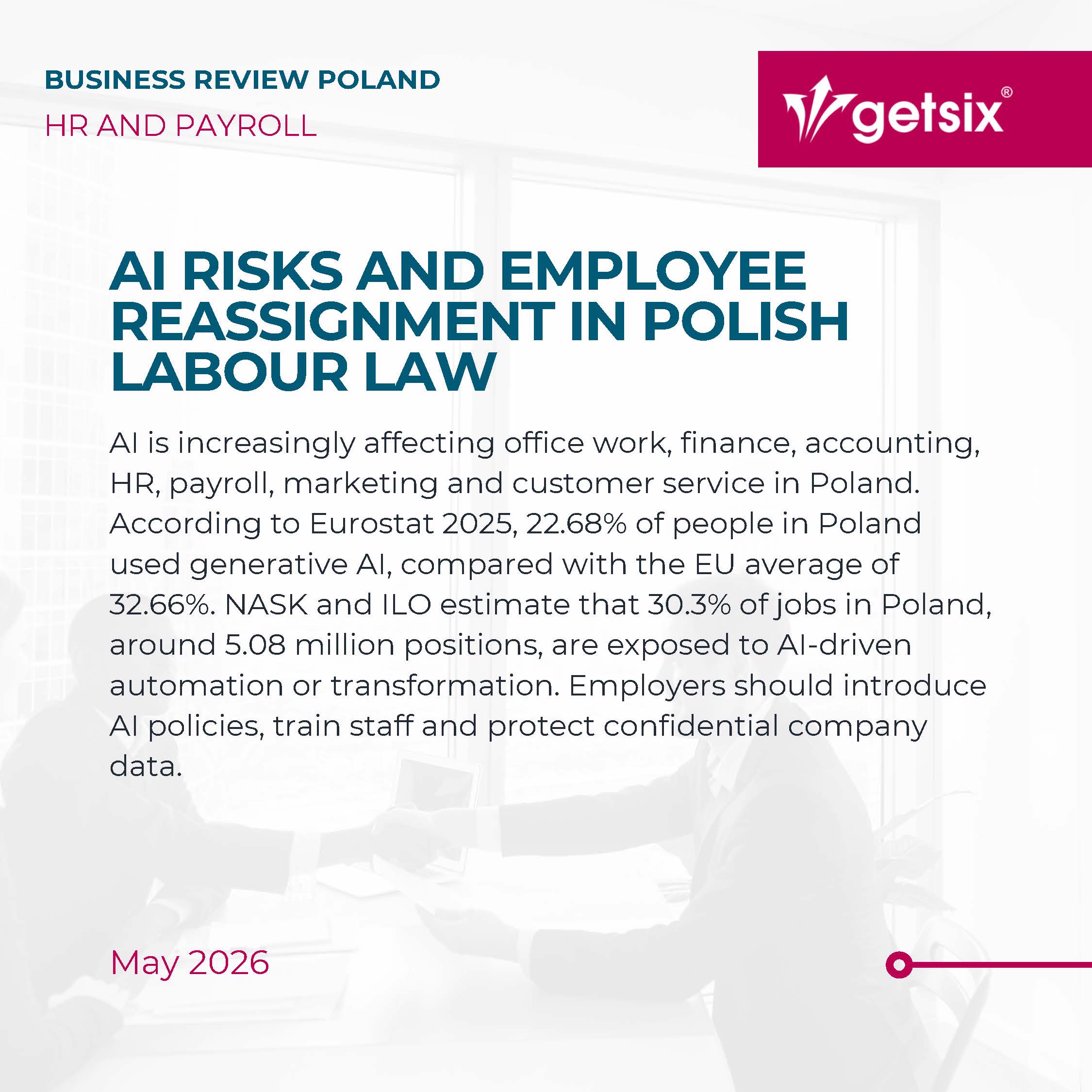
Polish employers should pay attention to three important areas of labour law in Poland: new rules on collective labour agreements, legal risks connected with the use of AI tools at work, and the limits of temporary reassignment under Article 42 § 4 of the Polish Labour Code. The Act of 5 November 2025 on collective labour agreements and collective arrangements replaced the previous regulations contained in the Labour Code of 1974 and aims to strengthen social dialogue in Poland. The new rules allow company-level and supra-company collective agreements to regulate broader workplace matters, including work-life balance, the use of new technologies, gender equality, anti-mobbing procedures and psychosocial risks such as stress or burnout. At the same time, the growing use of AI tools by employees increases legal risks where confidential business data, HR information, contract excerpts, client databases or whistleblower reports are entered into external systems. Employers should also remember that temporary reassignment to other work is possible only for up to three months in a calendar year, provided that remuneration is not reduced and the assigned work corresponds to the employee’s qualifications. For businesses in Poland, this highlights the need for clear internal AI policies, well-documented HR decisions and compliance-oriented workforce management.
Read the article for more details: Collective agreements, AI risks and employee duties in Poland
Tax audits in Poland – how KSeF and JPK_CIT are changing tax supervision
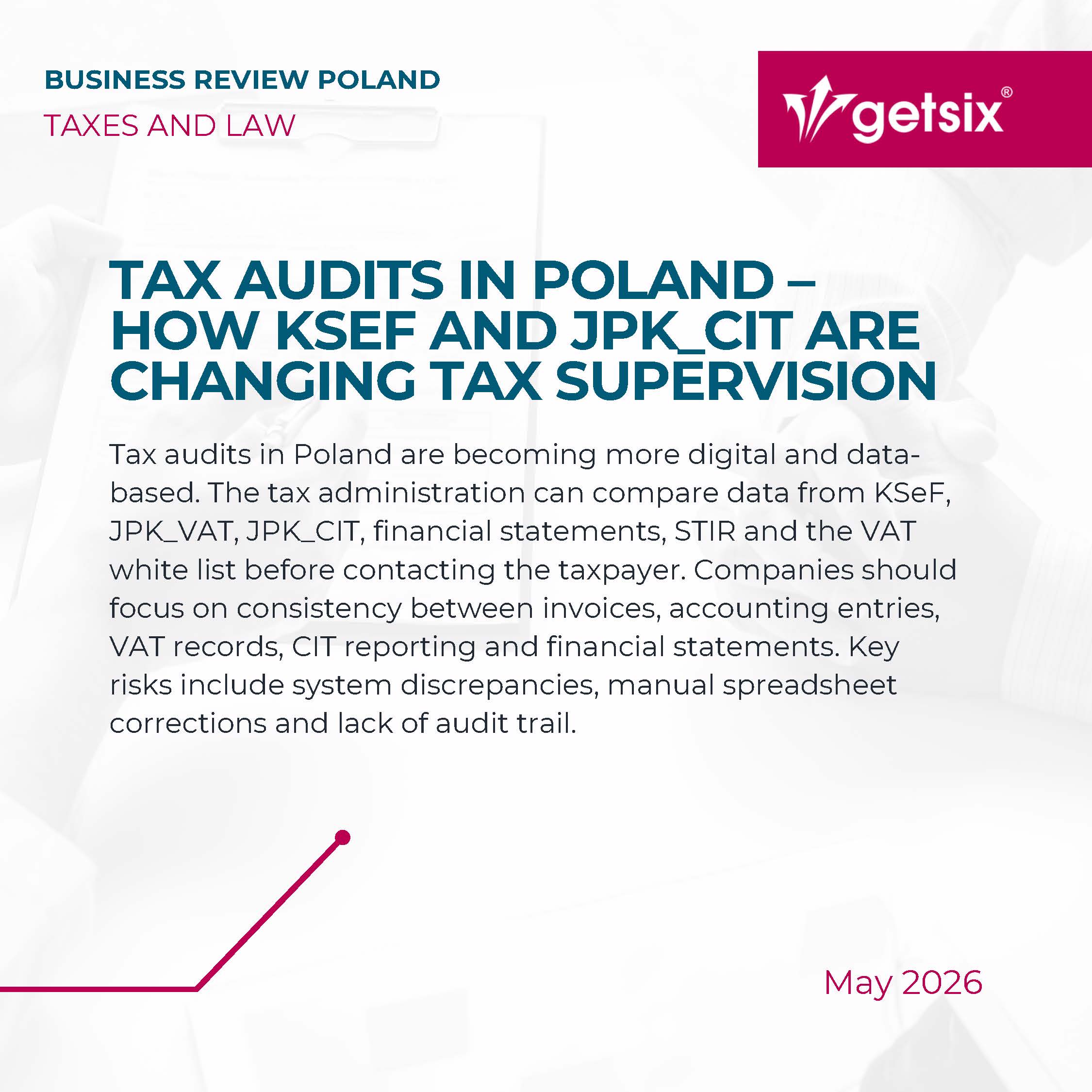
Tax audits in Poland are increasingly moving towards a digital, data-driven supervision model. The Polish tax administration can analyse taxpayers’ data before initiating formal contact with a company, using information from KSeF, JPK_VAT, electronic financial statements, STIR, the VAT taxpayers white list and future JPK_CIT structures. For businesses, the practical implication is clear: tax compliance will no longer be assessed only on the basis of the final tax return, but also through the consistency of data across invoices, accounting entries, VAT records, CIT reporting, KSeF data and financial statements. Companies should prepare for more precise questions from tax authorities, for example regarding specific invoices, selected transactions, discrepancies between systems, cost classification, correction history or the moment of revenue and cost recognition. The main risk areas include differences between ERP, sales, workflow and accounting systems, manual spreadsheet-based corrections, repeated errors caused by automation and the lack of a clear audit trail. In the era of digital tax audits, data quality, transaction-level reconciliation and process documentation are becoming key elements of tax risk management in Poland.
Read the article for more details: Tax audits in Poland in the era of KSeF and JPK_CIT
AI and the labour market in Poland – opportunities, risks and challenges for employers
Artificial intelligence is becoming an increasingly important factor in the Polish labour market, especially in office work, administration, finance, accounting, HR, payroll, marketing and customer service. According to Eurostat data for 2025, 22.68% of people in Poland used generative AI tools in the previous three months, compared with the EU average of 32.66%. Among pupils and students using GenAI for formal education purposes, the figure was 37.12% in Poland and 52.99% in the EU. Research by NASK and the International Labour Organization indicates that around 30.3% of jobs in Poland, or approximately 5.08 million positions, show some degree of exposure to automation or transformation linked to generative AI. Around 817,500 employees, or 4.9% of those employed, work in occupations with the highest exposure. The impact is particularly visible among office workers, where 71.2% are exposed to GenAI to varying degrees and 47.2% fall into the highest exposure category. For employers, AI creates opportunities to improve productivity, automate repetitive tasks and accelerate reporting, but it also increases risks related to data protection, trade secrets, inaccurate outputs, informal AI use and skills gaps. Companies in Poland should introduce clear AI usage rules, train employees and define which business processes may be supported by AI only under expert supervision.
Read the article for more details: AI and the labour market in Poland – opportunities for employers
Transfer pricing in Poland in 2026 – schemas, forms and reporting changes
Transfer pricing in Poland in 2026 remains one of the most demanding areas of tax compliance, especially as reporting obligations become increasingly data-driven and interconnected. Transfer pricing is no longer only a documentation requirement; it is also an analytical area used by the Polish tax authorities to compare taxpayers across years, sectors and reporting sources. In 2026, companies should pay particular attention to the consistency of data reported in TPR-C, TPR-P, Country-by-Country Reporting (CbC), public CbC reporting (PCbCR), accounting books, statutory financial statements, CIT-8, KSeF, IFT-R and future JPK_CIT structures. The Ministry of Finance has published TPR schema variant 6, including TPR-C(6) and TPR-P(6), which means that companies should verify whether their internal systems and reporting tools can generate compliant data. For calendar-year taxpayers, the key transfer pricing deadlines remain: Local File by the end of the 10th month after the tax year-end, TPR by the end of the 11th month, and Master File by the end of the 12th month. In practice, this means October, November and December for taxpayers whose tax year equals the calendar year. Large groups should also prepare for public CbC reporting, with the first public report for financial year 2025 expected by the end of 2026, where applicable. For CFOs and management boards, transfer pricing should be treated as a year-round compliance and risk management process based on reliable transaction mapping, benchmarking, documented business rationale and reconciliation with accounting data.
Read the article for more details: Transfer pricing in Poland in 2026: schemas and forms
The key business trends in May 2026 show that Polish compliance is becoming increasingly digital, data-based and process-oriented. KSeF changes the handling of VAT corrections, JPK_CIT strengthens the importance of accounting data, tax audits are moving towards earlier digital verification, transfer pricing reporting requires stronger reconciliation, and AI creates both productivity opportunities and legal risks for employers. For companies operating in Poland, the most important priority is to ensure consistent data, clear internal procedures, well-documented decisions and close cooperation between finance, tax, HR, IT and management teams.
At getsix®, we support companies by providing a full range of services in the areas of accounting in Poland, tax advisory in Poland, HR and payroll Poland, as well as company registration, administrative support, reporting and international advisory services.
If you have any questions regarding this topic or if you are in need for any additional information – please do not hesitate to contact us:
CUSTOMER RELATIONSHIPS DEPARTMENT

ELŻBIETA
NARON-GROCHALSKA
Head of Customer Relationships
Department / Senior Manager
getsix® Group

***