
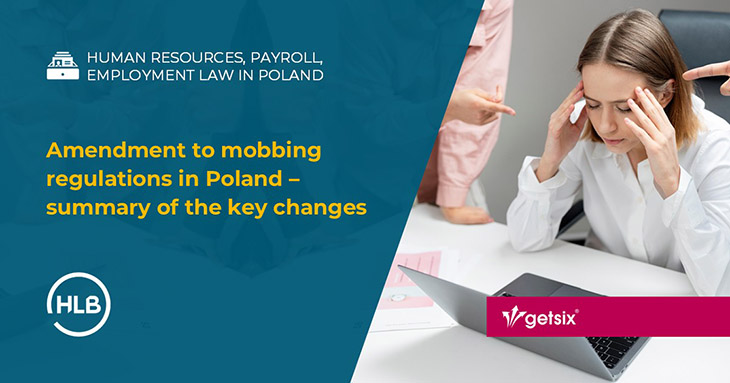
Amendment to mobbing regulations in Poland – summary of the key changes
In this article:
New definition of mobbing adopted by the Polish Sejm
On 19 June 2026, the Sejm, the lower house of the Polish Parliament, adopted the Act amending the Labour Code and the Code of Civil Procedure (hereinafter: the “Act”), which introduces a new definition of mobbing, increases the minimum amount of compensation for mobbing, and imposes an obligation on employers to define the rules, procedures and frequency of actions aimed at preventing mobbing. The Act also modifies provisions concerning equal treatment in employment.
Update: The President has signed the Act
On 30 July 2026, the President of the Republic of Poland signed the Act amending the provisions concerning mobbing, discrimination and the protection of employees’ personal rights.
The Act will enter into force three months after its publication in the Journal of Laws. Employers will then have six months to implement the required regulations and procedures.
Simplified definition
The Act provides for a simplified definition of mobbing, which is to be understood as behaviour involving persistent harassment of an employee.
Incidental behaviour will not constitute mobbing, even if it infringes the employee’s personal rights.
The Act specifies examples of mobbing, which may include in particular: humiliating, insulting, intimidating, underestimating an employee’s professional usefulness, unjustified criticism, degrading or ridiculing an employee.
Amount of compensation
Under the provisions of the Act, an employee who has experienced mobbing will be entitled to claim compensation from the employer in an amount not lower than six times the minimum wage.
An employer who has paid compensation or damages in connection with mobbing will be entitled to seek reimbursement of the damage suffered from the person whose behaviour constituted mobbing, to the extent corresponding to that person’s degree of fault and the employer’s degree of fault in causing the damage.
Obligation to define rules, procedures and frequency of actions
An employer employing at least 10 employees will be required to establish rules, procedures and the frequency of actions in the areas of preventing violations of dignity and other personal rights of employees, preventing violations of the principle of equal treatment in employment, preventing discrimination and preventing mobbing in workplace regulations, unless such rules, procedures and frequency of actions are already specified in a collective labour agreement or workplace regulations.
Changes to equal treatment provisions
The new provisions state that discrimination will also include situations where an employee is treated less favourably in a comparable situation than another employee is, was or would be treated, even where the specific reason has been wrongly attributed to that employee (discrimination by assumption), or where there is a connection with a person to whom that reason actually applies (discrimination by association).
Importantly, unequal treatment will be permissible and will not constitute discrimination if it is objectively justified.
Entry into force
The Act will enter into force 3 months after its publication. Employers will be required to adapt their workplace regulations to the requirements set out in the Act, or to issue regulations containing rules, procedures and the frequency of actions in the areas of preventing violations, within 6 months from the date on which the Act enters into force. We will continue to provide updates on further changes.
 Source: The article was created in collaboration with our cooperation partner – sdzlegal Schindhelm Law Office
If you have any questions regarding this topic or if you are in need for any additional information – please do not hesitate to contact us:
CUSTOMER RELATIONSHIPS DEPARTMENT

ELŻBIETA
NARON-GROCHALSKA
Head of Customer Relationships
Department / Senior Manager
getsix® Group

***