

Business Review Poland – April 2026
April 2026 brought further important developments for businesses operating in Poland, particularly in the areas of e-invoicing, HR and payroll compliance, corporate income tax, withholding tax and Estonian CIT. For entrepreneurs, these changes confirm the growing importance of structured internal procedures, reliable documentation and proactive tax risk management.
In this review, we present the most important developments of the past month that shape the conditions for doing business in Poland.
In this article:
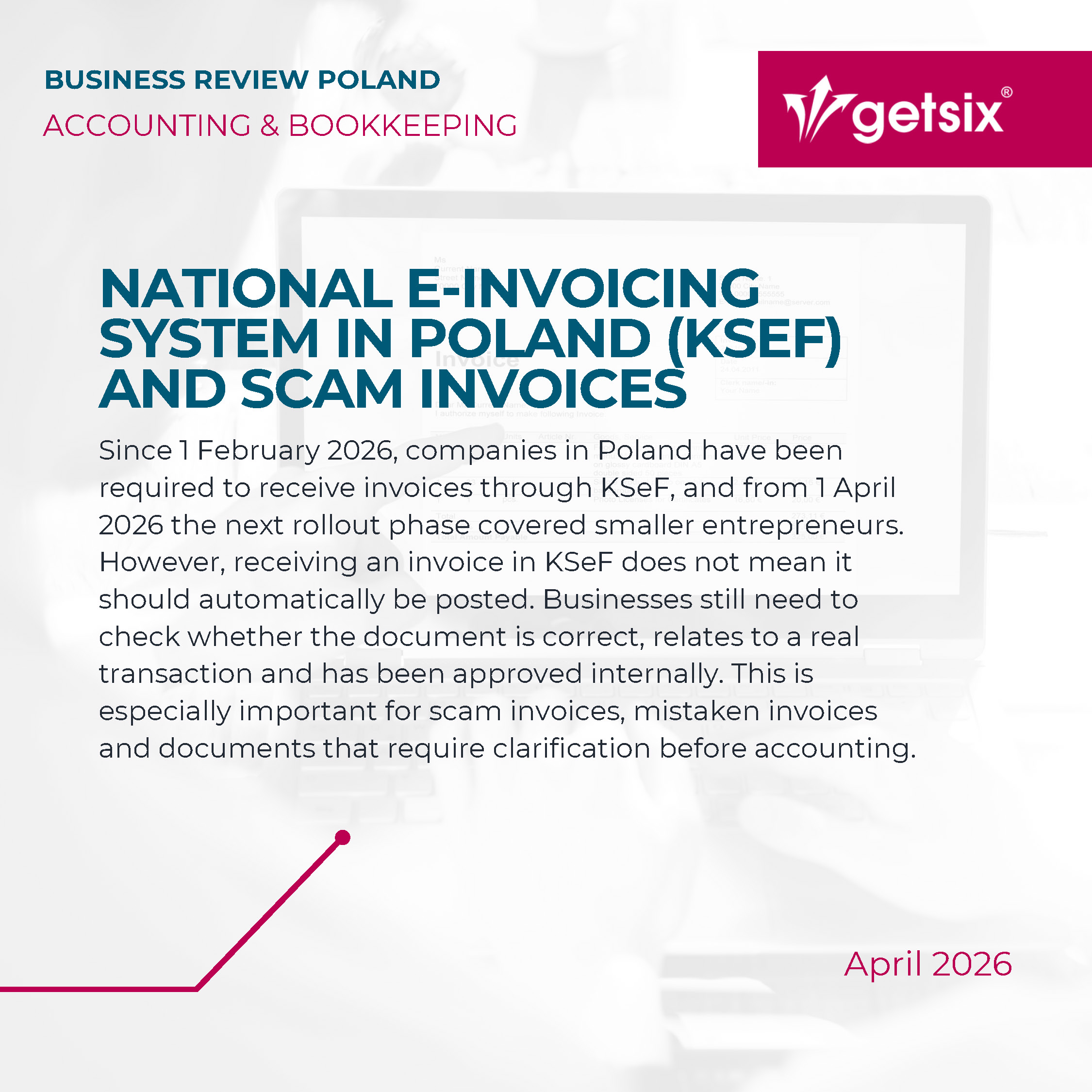
National e-Invoicing System in Poland (KSeF) and scam invoices: why document control is essential
Since 1 February 2026, the production version of KSeF 2.0 has been operating in Poland, and the obligation to receive invoices through the system has applied from that date. From 1 April 2026, the second phase of the rollout also covered entrepreneurs whose 2024 sales value did not exceed PLN 200 million. Although the Ministry of Finance has announced that sanctions for errors in using KSeF will not be imposed in 2026 during the transitional period, companies should not treat this as a reason to limit their focus to the technical import of invoices. KSeF organises the issuing, receipt and storage of structured invoices, but it does not verify whether a document reflects a real transaction, whether it was issued correctly, or whether it should be accepted for accounting. This is particularly important in the context of scam invoices, mistaken invoices and documents requiring business approval before posting. For businesses in Poland, KSeF implementation should therefore be treated not only as a technological change, but also as an opportunity to strengthen invoice workflow, cost approval procedures and document control before incorrect or unclear invoices reach the accounting books.
Read the article for more details: National e-Invoicing System in Poland (KSeF) and scam invoices.
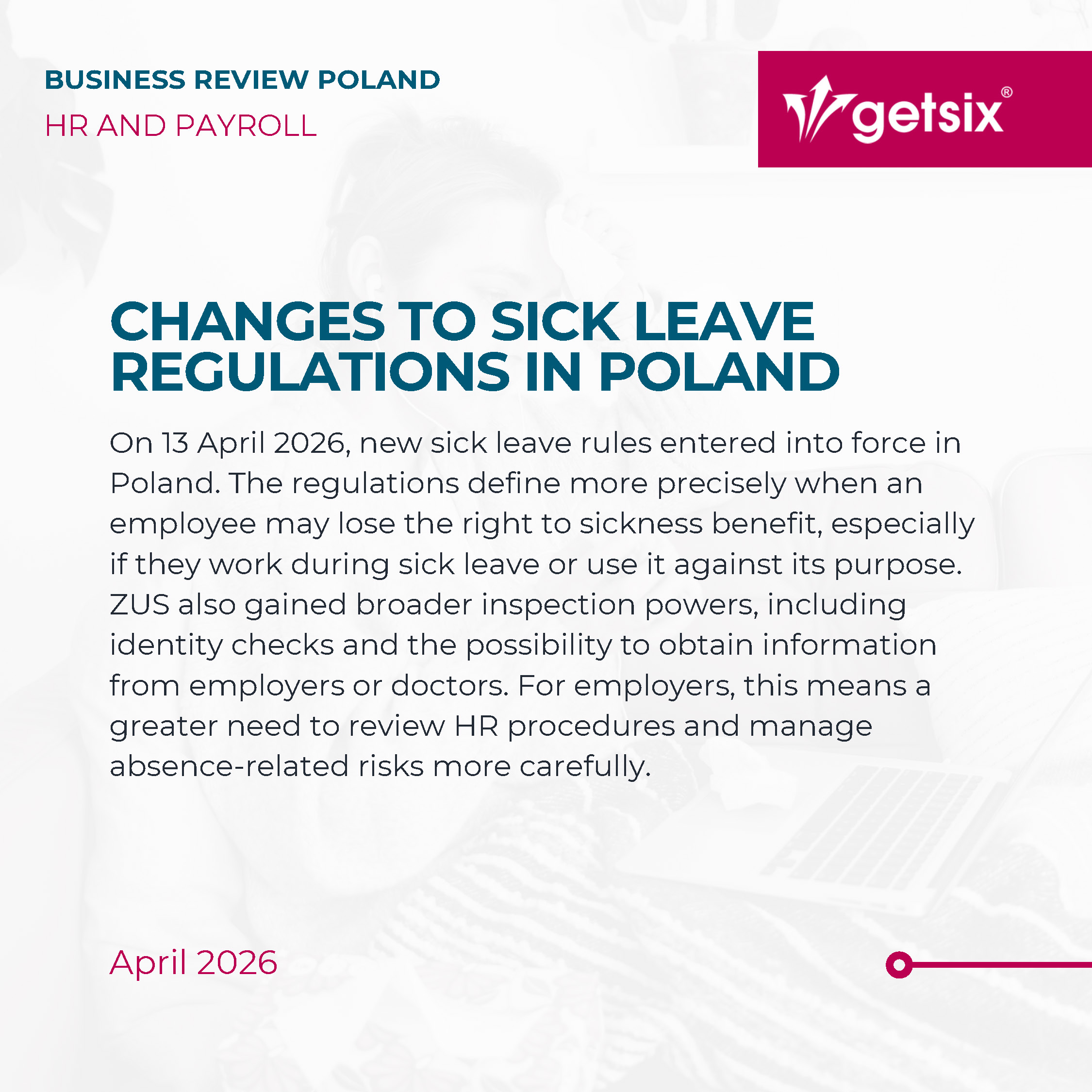
Changes to sick leave regulations – new rules, ZUS inspections, and impact on benefit entitlement in Poland
On 13 April 2026, amendments to sick leave regulations entered into force in Poland, introducing more precise rules on how sick leave may be used and when an insured person may lose the right to sickness benefit. The new provisions clarify that benefit entitlement may be lost if the insured person undertakes gainful employment or performs activities inconsistent with the purpose of the sick leave. At the same time, the regulations now recognise the concept of incidental activities required by important circumstances, which may reduce uncertainty in minor, exceptional cases. The amendment also expands the inspection powers of the Social Insurance Institution (ZUS), including identity verification, access to the place of inspection and the ability to obtain information from the treating physician or employer. From a payroll and HR perspective, the changes are significant because they require employers to understand not only the formal rules for sick leave, but also the practical consequences for benefit entitlement, internal communication and cooperation during ZUS inspections. Further changes will follow from 1 January 2027, when sick leave certificates may be issued under a single insurance title, which will be particularly relevant for individuals working in more than one job.
Read the article for more details: Sick leave – changes, controls and right to benefits.
Contractual penalties and tax-deductible costs in Poland – a ruling by the Supreme Administrative Court of Poland (NSA)
The judgment of the Supreme Administrative Court of Poland of 9 October 2025, case ref. II FSK 1655/24, provides important guidance for companies dealing with contractual penalties in Poland. The NSA confirmed that not every contractual penalty is automatically excluded from tax-deductible costs. The key distinction lies in whether the penalty relates to defects in goods, works or services, or whether it concerns delay in performance that is not linked to defective performance. Article 16(1)(22) of the Polish CIT Act excludes only specific categories of penalties and damages, including those connected with defects or delays in removing defects, and should be interpreted strictly. This means that a penalty for delay may potentially be deductible if it meets the general conditions under Article 15(1) of the Polish CIT Act, including a connection with business activity, proper documentation and a commercial rationale linked to generating income or preserving its source. For businesses operating under long-term contracts, construction projects, deliveries or service arrangements, the ruling reinforces the need to review contract wording, document the reasons for delays and assess the tax treatment of penalties before recognising them in CIT settlements.
Read the article for more details: Contractual penalties and tax-deductible costs in Poland.
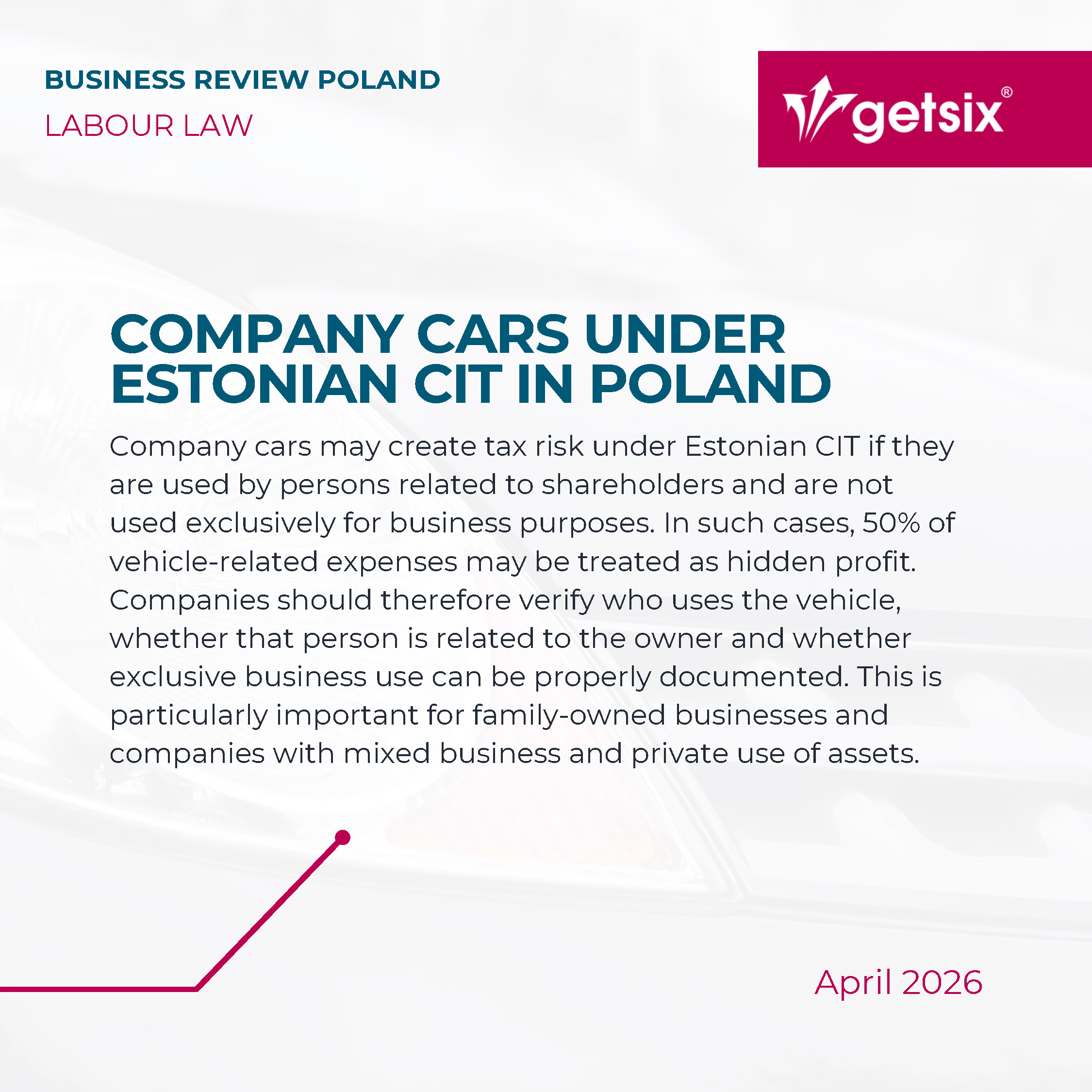
Company car in Estonian CIT in Poland – when 50% of expenses become hidden profit
The judgment of the Supreme Administrative Court of Poland of 20 November 2025, case ref. II FSK 397/23, highlights a significant tax risk for companies applying Estonian CIT in Poland. A company car may be a standard business tool, but where it is used by a person related to a shareholder and is not used exclusively for business purposes, 50% of vehicle-related expenses may be treated as hidden profit and taxed under the lump-sum regime. The issue is particularly sensitive in family-owned companies and businesses where related persons are employed by the company and use company vehicles. Employee status alone does not eliminate the risk if the benefit may be linked to the ownership sphere. Since 1 January 2023, Polish CIT rules also require a clear distinction between hidden profits and expenses unrelated to business activity, making it essential to identify who uses the vehicle, whether that person is related to the shareholder, and whether exclusive business use can be proven. For companies applying Estonian CIT, this area should be part of ongoing tax compliance, supported by internal car-use policies, reliable records and regular verification of whether taxable income has arisen.
Read the article for more details: Company car in Estonian CIT in Poland and hidden profit.
Withholding tax (WHT) on hosting services in Poland – Supreme Administrative Court of Poland (NSA) judgment
The NSA judgment of 30 October 2025, case ref. II FSK 183/23, strengthens a taxpayer-unfavourable approach to withholding tax in Poland in relation to hosting and selected digital services. The Court accepted that, in a specific settlement model, payments for hosting may be connected with the use of technical infrastructure and may therefore fall within the scope of WHT under the Polish CIT Act. This is particularly relevant for companies making payments to foreign providers of hosting, server infrastructure, cloud solutions, analytics tools or other technology-related services. The judgment confirms that the commercial name of a service is not decisive; what matters is the actual nature of the service, the user’s rights, the settlement model and whether the payment can be linked to the use of equipment or similar intangible services. Together with the NSA judgment of 9 October 2025, case ref. II FSK 112/23, concerning a broad approach to similar services under Article 21(1)(2a) of the Polish CIT Act, this development shows that WHT compliance is becoming a more sensitive area for Polish payers. Businesses should review contracts, verify certificates of residence, assess double tax treaty application and ensure due diligence before making cross-border payments.
Read the article for more details: Withholding tax (WHT) on hosting services in Poland.
The key developments of April 2026 show a clear trend towards more structured compliance, stronger documentation requirements and broader tax risk assessment in Poland. KSeF implementation is no longer only an IT project, but also a document control challenge. Sick leave changes increase the importance of HR and payroll procedures. Recent NSA judgments confirm that contractual penalties, company cars under Estonian CIT and cross-border payments for digital services require careful, case-by-case tax analysis. For businesses, the common denominator is clear: internal procedures, reliable evidence and early review are becoming essential for safe operations in Poland.
In getsix® we support companies by providing a full range of services in the areas of accounting in Poland, taxes, HR and payroll Poland, as well as company registration, administrative support, reporting and international advisory both in Poland and abroad.
If you have any questions regarding this topic or if you are in need for any additional information – please do not hesitate to contact us:
CUSTOMER RELATIONSHIPS DEPARTMENT

ELŻBIETA
NARON-GROCHALSKA
Head of Customer Relationships
Department / Senior Manager
getsix® Group

***