


Business Review Poland – September 2026
September 2026 brought material tax, payroll and employment developments affecting companies operating in Poland.
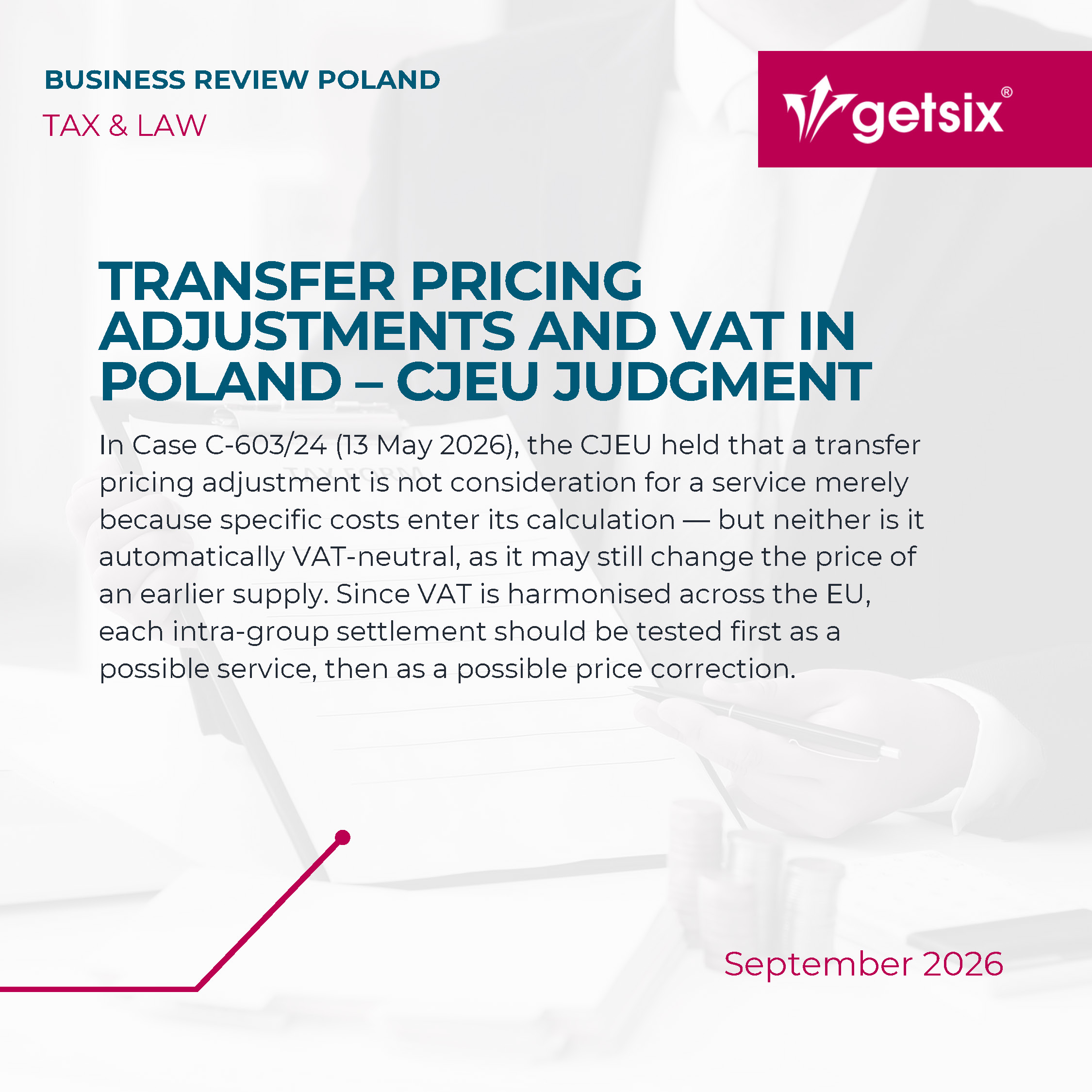
The CJEU ruled that a transfer pricing adjustment is not automatically subject to VAT; its economic function and link to a supply must be assessed.
From 1 January 2027, Poland’s minimum wage will rise to PLN 4,950 gross per month, while the minimum hourly rate will increase to PLN 32.30 gross.
State Labour Inspection (PIP) interpretations assess mandate and B2B contracts based on actual working conditions, including subordination and independence.
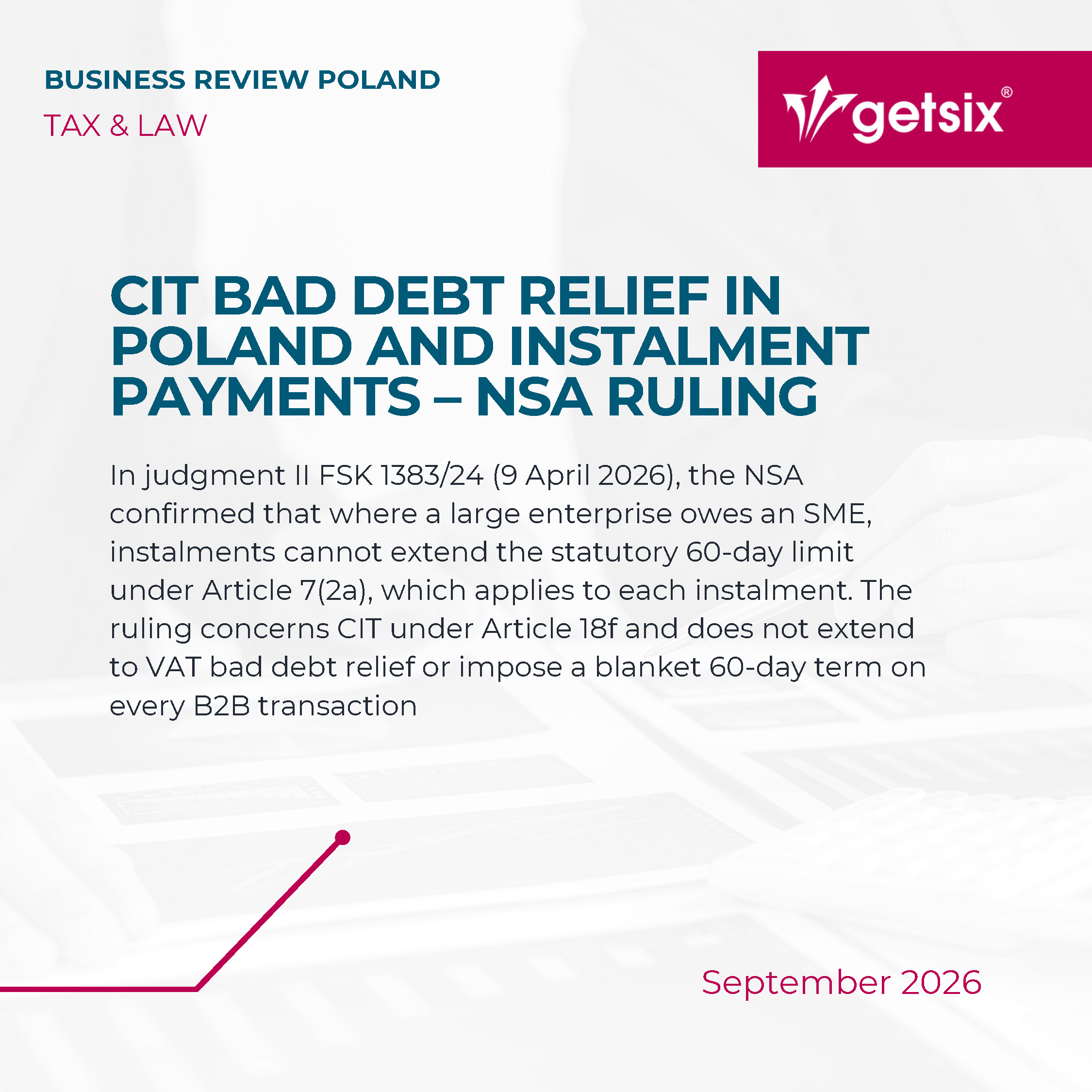
The Supreme Administrative Court of Poland (NSA) ruled in case II FSK 1383/24 that the statutory 60-day payment limit applies to each instalment covered by the ruling.
Substance determines VAT treatment
Intra-group settlements should be assessed as possible service consideration and then as possible price corrections.
Employment classification depends on working reality
In Poland, contractual labels do not override the actual organisation and conditions of the working relationship.
Higher employment costs require 2027 planning
The confirmed minimum wage increase affects payroll parameters, part-time calculations and remuneration budgets.
Instalment schedules can affect CIT adjustments
Companies should verify counterparty status and the payment dates that determine CIT bad debt relief.
September 2026 brought a cluster of developments reaching into almost every corner of the finance and HR function for companies operating in Poland — from a fresh CJEU ruling on how transfer pricing adjustments interact with VAT, to a confirmed minimum wage rise for 2027 and the first published State Labour Inspection interpretations on when a contractor is, in substance, an employee. For businesses managing accounting, tax and payroll obligations in Poland, none of this is abstract: each item carries concrete consequences for settlements, employment costs and compliance risk. Keeping pace with the changes is what lets finance teams plan rather than react.
In this monthly business review, we present the most important developments from the past month that affect the conditions for doing business in Poland.
In this article:
Transfer pricing adjustments and VAT in Poland – CJEU judgment
On 13 May 2026 the Court of Justice of the European Union delivered its judgment in Case C-603/24, addressing a question that has troubled corporate groups for years: when does a transfer pricing adjustment become subject to VAT? The Court’s answer resists any single automatic rule. A profitability adjustment does not turn into consideration for a service merely because particular costs — here, warranty repair costs within an automotive group — are folded into its calculation; what matters is whether there is a direct link between the payment and an identifiable supply, supported by reciprocal obligations between the parties. Crucially, the absence of such a service does not push the adjustment outside VAT altogether, since, as the Court noted in paragraph 47, it may still alter the price and taxable amount of an earlier supply. The ruling sits alongside the earlier Arcomet Towercranes decision (Case C-726/23, 4 September 2025), the differing outcomes reflecting differences in the underlying contracts rather than any change of direction. Because VAT is harmonised across the EU, the interpretation feeds directly into how Polish VAT rules are read. In practice, this means each intra-group settlement should be tested in two stages — first as possible consideration for a service, then as a possible price correction — before any conclusion on VAT neutrality is drawn.
Read the article for more details: Transfer pricing adjustments and VAT in Poland – CJEU judgment
Minimum wage in Poland 2027: PLN 4,950 gross from 1 January
The Regulation of the Council of Ministers of 14 September 2026 (Journal of Laws 2026, item 1213) has confirmed the statutory minimum pay levels for the coming year. From 1 January 2027, the minimum monthly wage for a full-time employee rises to PLN 4,950 gross — an increase of PLN 144 on the 2026 figure of PLN 4,806 — while the minimum hourly rate for covered civil-law contracts climbs to PLN 32.30 gross, up PLN 0.90 from PLN 31.40. On an illustrative basis, a qualifying employee would receive roughly PLN 3,703.93 net, with the total monthly cost to the employer reaching approximately PLN 5,963.77, assuming a 1.67% accident insurance rate and no employer-financed PPK contributions. The headline rate is only part of the picture: not every payment counts towards the statutory minimum, and components such as overtime pay, night-work allowances, length-of-service allowances and jubilee awards remain excluded under the current rules. Employers should also note that legislative work on the method of setting the minimum wage is still under way, so the framework is worth rechecking closer to year-end. In practice, this means payroll parameters, part-time calculations and 2027 remuneration budgets should be reviewed now, with particular attention to staff already sitting at or near the statutory floor.
Read the article for more details: Minimum wage in Poland 2027

When can a mandate contract or B2B arrangement be treated as employment relationship in Poland? First State Labour Inspection (PIP) interpretations
The State Labour Inspection (PIP), acting through the Chief Labour Inspector (GIP), has begun issuing its first individual interpretations on a question that carries real financial weight: when does a mandate contract or B2B arrangement actually amount to an employment relationship? The assessment turns on Article 22 § 1 of the Polish Labour Code and looks past the label on the contract to how the cooperation is genuinely organised — weighing subordination, who sets the time and place of work, the contractor's independence, the possibility of genuine substitution and the extent of business risk borne. One of the more instructive threads running through the early decisions is the distinction between freedom before an assignment is accepted and independence once it is under way; the right to decline work does not, on its own, make a relationship civil-law in nature. The interpretations also confirm that B2B cooperation can withstand scrutiny where independence is real — no ongoing management, freedom to organise the work and a true assumption of risk. A favourable interpretation binds PIP only to the facts set out in the application, and it does not shield a company from a subsequent inspection if practice diverges from what was presented. This is a live risk for international groups, where a contract drafted centrally may not reflect how a local manager in Poland actually runs the working relationship. In practice, this means contract templates should be measured against day-to-day operational reality before an inspection — or an interpretation application — rather than after.
Read the article for more details: Mandate and B2B contracts in Poland: first PIP interpretations
CIT bad debt relief in Poland and instalment payments – Supreme Administrative Court of Poland (NSA) ruling
In its judgment of 9 April 2026 (case no. II FSK 1383/24), the Supreme Administrative Court of Poland (NSA) settled an important point on CIT bad debt relief: where a large enterprise owes a micro, small or medium-sized enterprise, splitting the payment into instalments cannot be used to stretch the statutory 60-day payment limit. That cap under Article 7(2a) of the Act on Counteracting Excessive Delays in Commercial Transactions applies to each instalment, not merely to the payment as a whole. The consequence for corporate income tax flows from the interaction of two provisions of the CIT Act: Article 18f(11) starts the 90-day bad debt clock on the first day after the payment deadline expires, while Article 18f(15) requires a contractual date that breaches the anti-delay rules to be replaced by the statutory one. It is worth remembering that the relief cuts both ways — the creditor may reduce its taxable base, but the debtor must increase it, a distinction the Director of the National Revenue Information reaffirmed in an individual ruling of 19 May 2026. The Court's reasoning does not extend to VAT bad debt relief, which is governed separately, nor does it impose a blanket 60-day ceiling on every B2B transaction in Poland. In practice, this means companies using multi-month instalment schedules should verify their counterparty's status and confirm that the payment dates recorded in their accounting systems are the ones that actually govern the CIT adjustment.
Read the article for more details: CIT bad debt relief in Poland: instalments and 60-day limit
Taken together, September's developments point in a familiar direction: closer scrutiny of substance over form — whether in the VAT treatment of intra-group settlements, the classification of working relationships or the timing of tax adjustments — set against steadily rising employment costs. For companies operating in Poland, the practical thread is the same: contractual wording, accounting records and day-to-day practice increasingly need to tell one consistent story.
At getsix®, we support businesses by providing a full range of services in accounting in Poland, tax, HR and payroll Poland, as well as company registration, administrative support, reporting, and international advisory both in Poland and abroad.
 This article was written by the getsix® Editorial Team
getsix® provides accounting, tax advisory, HR and payroll, and business consulting services, supporting companies operating in Poland. The getsix® Editorial Team prepares practical information that makes Polish accounting, tax, and HR and payroll matters easier to understand.
If you have any questions regarding this topic or if you are in need for any additional information – please do not hesitate to contact us:
CUSTOMER RELATIONSHIPS DEPARTMENT

ELŻBIETA
NARON-GROCHALSKA
Head of Customer Relationships
Department / Senior Manager
getsix® Group

***